17/08/2013

And the rivers run through it

My oh my, how time does fly. Some many places have been seen and so little time to share them. A while back I was able to visit Scotland for a wee while, overlapping with a long overdue reunion with friends that I met while walking the Camino de Santiago a few years back. A weekend wash-out in true Scottish style, we attempted to climb Glencoe but the winds were too fierce up at the top, so we ended up doing a shorter walk through woodlands and inbetween soft winding rivers. A fellow mountaineer pointed out dwarf trees that grow in patchy mosaics in high altitudes. These mini birches find it hard to grow against the wind and cold of these bleak windswept mountains, and I found the idea of stunted trees in such a wet climate somewhat fascinating.

I was lucky enough to spot Loch Ness, stare at snow-spattered mountain tops and moss over every surface. Old abandoned castles draped in ivy, and quiet plains with not a soul walking on them. I came across a soft-spoken man, with even softer-spoken eyes who told me about the living architecture he had just built out of willow. It turns out he was a MacDougall son, whose estate I was wandering on. He was worried the willow would rot from all the rain they had been given, and can be found just behind Dunollie Castle, on land his family clan has owned for over a thousand years. It overlooks Oban, a sleepy seaside town, where days were quiet and nights even quieter. A brisk walk west of the town, you can catch a ferry across to Kerrera, an island also owned by the Macdougalls, and walk to see Gylen castle. Stop off at Kerrera Tea Garden just by the castle for some soup to warm up if you ever walk there, you will most likely need to dry off at some point. 

You walk alone, past grazing pastures and wonder what residents do on such a lonely island. It was lambing season, and all you could see were little white shadows following their mothers. A women who offered me a lift said that they were coming up to 9 months and would be taken from their mothers soon. I was relieved I would not be around to hear their mothers wail for them to come back to them. In Scotland's harsh yet beautiful vistas lay its sadness. Such a beautiful landscape changed irrevocably to feed man's hunger, coming across no native wildlife, only animals to eat.


07/07/2013

Living in East London

A favourite East London pastime of mine is cycling along the canals in the area. It's a great way to avoid traffic and to spot some birdlife along the way. On a saturday morning, you start off by the Olympic Park in Stratford and follow the canals past local breweries, imposing gas work structures, cosy barges selling cups of tea and books, smiling poochers, pass the daffodils in Victoria Park, and then get to Broadway market just in time for some Vietnamese coffee and a pastry for breakfast. There you will find purple carrots, a french girl with an accordion singing for her supper, and something so symptomatic of East London. Streetart. Oh so much of it. On a sunday, you get yourself to Columbia Flower market close to Shoreditch and find nothing prettier in the whole city. An entire road closed off and filled with flowers for sale. If you get there just before 2pm, you can even haggle for them at a next-to-nothing price. Shoreditch itself is just eye-achingly crammed with streetart. Some famous artists, and some lesser known ones. You pass the infamous beigel shop that is ALWAYS busy, see sneakers in the sky, pass tattoo parlours and vintage clothing shops, and leave thinking about just how many lovely, gritty, messy and creative things there are to see in this part of the city.


23/06/2013

Forest Farm Peace Garden

Coming from a country with wide open spaces and fresh air, a need arises from time to time to seek out places where you can breath a little. It's a luxury to have a garden in London, and in my search to reconnect with the soil, I came across a community garden called the Forest Farm Peace Garden in Hainault. I wanted to get my fingers dirty again, plant, weed, learn about plant species and how to forage. I've discovered how to make charcoal sticks, how to drum (at the World Music Day event held today in fact), I've tasted soup made from stinging nettles, a weed delicious and high in minerals. I've seen a cob oven been built from scratch from natural materials, found out that you can eat rhubarb stems but not the leaves, but they can be used as a fertilizer tea. I've discovered that you can stick a willow branch into the ground and it will grow, and you can make seed pots out of newspaper. Every week, on wednesdays and fridays, is a chance to feel like you are in the countryside and away from the city. A chance to unravel, have a chat with like-minded folk, grow food from seed, get away from the laptop, and breath some fresh air again.


21/06/2013

Wondering, wandering

London can be quite a daunting place to visit, so many choices, so many places, so many tube stops to choose from. Which one is worth visiting? Do I wander around until I find something or do I have to know where I am going before I set off? Since I am virtually incapable of decision-making, the latter more planned approach seldom ever happens, and what I stumble across usually is just the case. Stumbled upon.

Whether it be amazing street art that pops out of nowhere along Regent's Canal, Dalston or Shoreditch (you can tell since I have been living in the East),all-of-a-sudden sun glares inside the Tate, Harrods' festive lights in June, a boutique JUST for umbrellas, kissing budgies, Barbican dark alleys, old clippings of the Queen in an underground wine bar, wonderfully empty streets in central early in the morning, a spraypainted christmas tree, looking up to see a car wrecked by a sculpture, a confrontational blue pigeon, a coffee shop offering coffee grounds for compost, or a walk on the Thames at low tide. Always exploring, and still so much to see.


10/06/2013

Glastonbury - England's Jerusalem

When I say I visited Glastonbury, most people asked why I didn't just visit during the festival, which is a shame as this wonderful little town has so much more to offer. We stayed just outside the main town at Bliss cottage run by Trish, where delicious vegetarian food was served in mismatched bowls, pancakes were topped with Somerset bee pollen and roasted walnuts, and walks were guided by a big and confident shaggy dog. A short walk away in between hedgerows and grazing fields we met Gog and Magog, two revered ancient oak trees steeped in Druidic significance, two ancient giants that gave into old age, or a fire, or a lighting bolt. Who knows, but seeing old beautiful trees is never lost on me and the hearsay added to their mystery.

We climbed up to the Tor, the highest point of Glastonbury, drum beats from Druids echoed across the countryside and called us upward. On a clear day you can see South Wales apparently. You can visit the Chalice Well (wells are said to be gateways to the spirit world), the red of the water is said to represent the rusty iron nails used at the Crucifixion, the water did taste quite iron-oxidey to spur imagination on. If you are lucky enough, you can stumble upon a medieval festival close the the Glastonbury Abbey, drink mead, meet soldiers ready for battle, and get serenaded to by a man with long silvery hair.

The town's ancient treasures are well hidden, without knowing you could drive past the town in a  few minutes without knowing that some of its sites are on "the holiest ground in England." In the husk of the Abbey is the supposed resting place of King Arthur, and where St. Joseph returned to England from the Holy Land as a Christian missionary, and he planted his staff – which burst into leaf and became the sacred Glastonbury thorn tree.

A place of magic and legend, pagan gods, soft souls and and holy thorn trees, secluded spots with streams, and hills haunted by the memories of ancient saints and heroes, an island of the blessed dead, and a gateway to the spirit realm.


27/05/2013

The waters of Sulis

Another visit to a World Heritage site! This time an entire city famed for its Roman remains and Palladian architecture, namely Bath in Somerset, a 3-odd bus hour ride from London. A place apparently first found by acorn-hunting pigs that wallowed in its healing spring waters and cured their skin ailments. We stayed just outside of Bath, in Bathford. You can follow the River Avon down to Bath, and pass lazy houseboats, spot stalking grey herons, riverside pubs and daffodil fields. If you are brave enough to stick your thumb out, you might get a houseboat give you a lift and teach you how to open and close locks! Best way to get to the city I reckon.

There are walking audio guides of the city (how thoughtful!), where you can gander past the honey-coloured limestone buildings so typical of this place. On the cathedral, make sure to look up and see the sad-looking souls clambering up the stony ladder to heaven,  haven't quite seen something like that on a church before to be honest. The Roman Baths themselves really are a wonder. Sulis, the Celtic nourishing, life-giving mother goddess evolved into Roman Minerva and her Greek counterpart Athena and has a temple dedicated to her inside the baths. Temple goers would give offerings by throwing coins into the baths for her to punish wrongdoers. On pewter scrolls you can read requests for Sulis Minerva to impair the physical and mental well-being of various perpetrators, by denying them sleep, ceasing normal bodily function or causing death, until the wrongdoing had been made right. Constellations of crimes beneath the steaming waters, waiting to be fixed.

Onto another famous lady, Jane Austen also lived here! We saw the only sketch ever done of Jane Austen (the original is in the National Portrait Gallery in London) it was done by her sister, apparently an unflattering representation of the author however, she was much more pretty than that. None of the books published in her lifetime had her name on them, they were described as being written "By a Lady".

Musicians playing in every street cove, Gorgon masks, steamy baths and spring sunsets. Oh and the best almond brioche. Ever. Not to be beat really.


24/05/2013

Canterbury tales

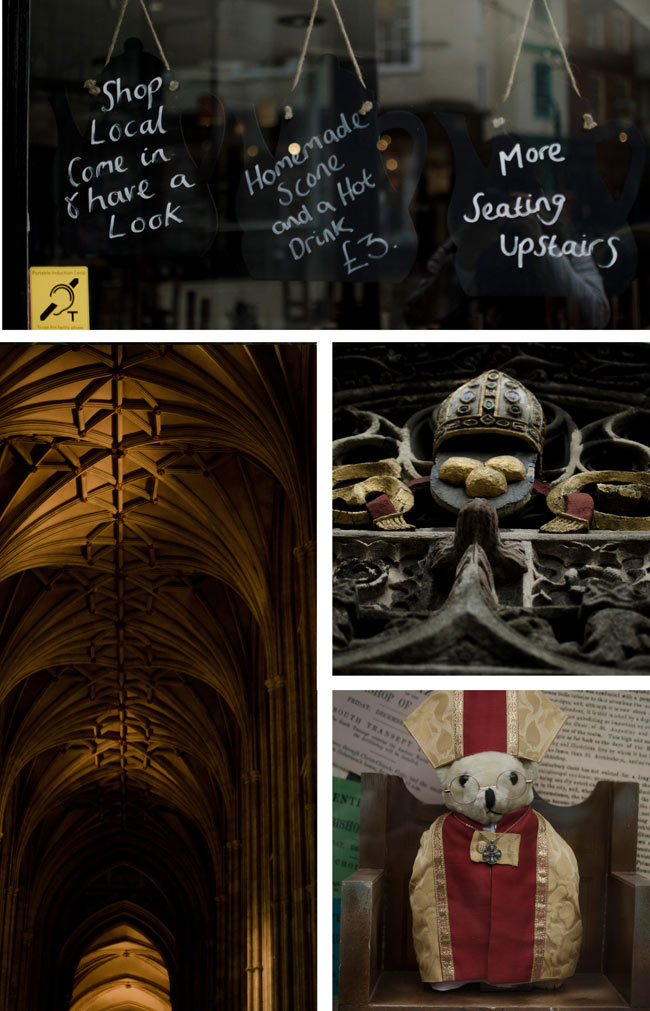
An hour train ride from London you come upon a town in Kent where most of it is a World Heritage site. Yes indeed. Canterbury has one of the oldest monuments to Christianity in the UK, built from stone imported from Normandy, and has stood on the site for over 1,400 years. The Mother Church of the Anglican faith and seat of the Archbishop of Canterbury (cute teddy bears of him can be found around the town if you fancy). Services are held at the Cathedral three or more times a day. We would know since we felicitously came to visit when a sermon was about to start = not having to pay the £9.50 entry fee. We went on Mother's Day and watched a lovely sermon where children handed out daffodil bouquets to everyone that attended. Those same bouquets were left in the hands of statues dedicated to Kent's King and Queen Ethelbert and Bertha, the sexy-as-hell-sounding couple that established the English-speaking Christian civilization that the British Empire became.

Did you know the equestrian word "canter" comes from Canterbury? After the murder of Archbishop Thomas Becket in the cathedral, pilgrims from all parts of Christendom came to visit his shrine. Many pilgrims on horseback who were nearing the city late at night would increase the horse's speed from a trot to the faster "Canterbury trot", but not as fast as a gallop. To "canter" became the shortened expression. It was a secret thrill to stumble upon a pilgrimage sign in front of the cathedral after so many years since doing the camino to Santiago. You can walk to Rome from here! Or walk from Rome to here!

The mind abuzz with walking the Via Francincigena, visiting the Beany House of Art and Knowledge with its miniature doll houses and textile art, tea breaks in cafes to warm up, coming across green and grey graveyards, ancient abbeys, wooden emblems and stained glass windows, this walkable town's slow pace and steeped Roman, Norman and medieval history is a well worth experiencing. Just avoid the Three Tuns if you are feeling peckish - worst pub food we've had to date, and that says alot!


Related Posts Plugin for WordPress, Blogger...