10/06/2013

Glastonbury - England's Jerusalem

When I say I visited Glastonbury, most people asked why I didn't just visit during the festival, which is a shame as this wonderful little town has so much more to offer. We stayed just outside the main town at Bliss cottage run by Trish, where delicious vegetarian food was served in mismatched bowls, pancakes were topped with Somerset bee pollen and roasted walnuts, and walks were guided by a big and confident shaggy dog. A short walk away in between hedgerows and grazing fields we met Gog and Magog, two revered ancient oak trees steeped in Druidic significance, two ancient giants that gave into old age, or a fire, or a lighting bolt. Who knows, but seeing old beautiful trees is never lost on me and the hearsay added to their mystery.

We climbed up to the Tor, the highest point of Glastonbury, drum beats from Druids echoed across the countryside and called us upward. On a clear day you can see South Wales apparently. You can visit the Chalice Well (wells are said to be gateways to the spirit world), the red of the water is said to represent the rusty iron nails used at the Crucifixion, the water did taste quite iron-oxidey to spur imagination on. If you are lucky enough, you can stumble upon a medieval festival close the the Glastonbury Abbey, drink mead, meet soldiers ready for battle, and get serenaded to by a man with long silvery hair.

The town's ancient treasures are well hidden, without knowing you could drive past the town in a  few minutes without knowing that some of its sites are on "the holiest ground in England." In the husk of the Abbey is the supposed resting place of King Arthur, and where St. Joseph returned to England from the Holy Land as a Christian missionary, and he planted his staff – which burst into leaf and became the sacred Glastonbury thorn tree.

A place of magic and legend, pagan gods, soft souls and and holy thorn trees, secluded spots with streams, and hills haunted by the memories of ancient saints and heroes, an island of the blessed dead, and a gateway to the spirit realm.


27/05/2013

The waters of Sulis

Another visit to a World Heritage site! This time an entire city famed for its Roman remains and Palladian architecture, namely Bath in Somerset, a 3-odd bus hour ride from London. A place apparently first found by acorn-hunting pigs that wallowed in its healing spring waters and cured their skin ailments. We stayed just outside of Bath, in Bathford. You can follow the River Avon down to Bath, and pass lazy houseboats, spot stalking grey herons, riverside pubs and daffodil fields. If you are brave enough to stick your thumb out, you might get a houseboat give you a lift and teach you how to open and close locks! Best way to get to the city I reckon.

There are walking audio guides of the city (how thoughtful!), where you can gander past the honey-coloured limestone buildings so typical of this place. On the cathedral, make sure to look up and see the sad-looking souls clambering up the stony ladder to heaven,  haven't quite seen something like that on a church before to be honest. The Roman Baths themselves really are a wonder. Sulis, the Celtic nourishing, life-giving mother goddess evolved into Roman Minerva and her Greek counterpart Athena and has a temple dedicated to her inside the baths. Temple goers would give offerings by throwing coins into the baths for her to punish wrongdoers. On pewter scrolls you can read requests for Sulis Minerva to impair the physical and mental well-being of various perpetrators, by denying them sleep, ceasing normal bodily function or causing death, until the wrongdoing had been made right. Constellations of crimes beneath the steaming waters, waiting to be fixed.

Onto another famous lady, Jane Austen also lived here! We saw the only sketch ever done of Jane Austen (the original is in the National Portrait Gallery in London) it was done by her sister, apparently an unflattering representation of the author however, she was much more pretty than that. None of the books published in her lifetime had her name on them, they were described as being written "By a Lady".

Musicians playing in every street cove, Gorgon masks, steamy baths and spring sunsets. Oh and the best almond brioche. Ever. Not to be beat really.


24/05/2013

Canterbury tales

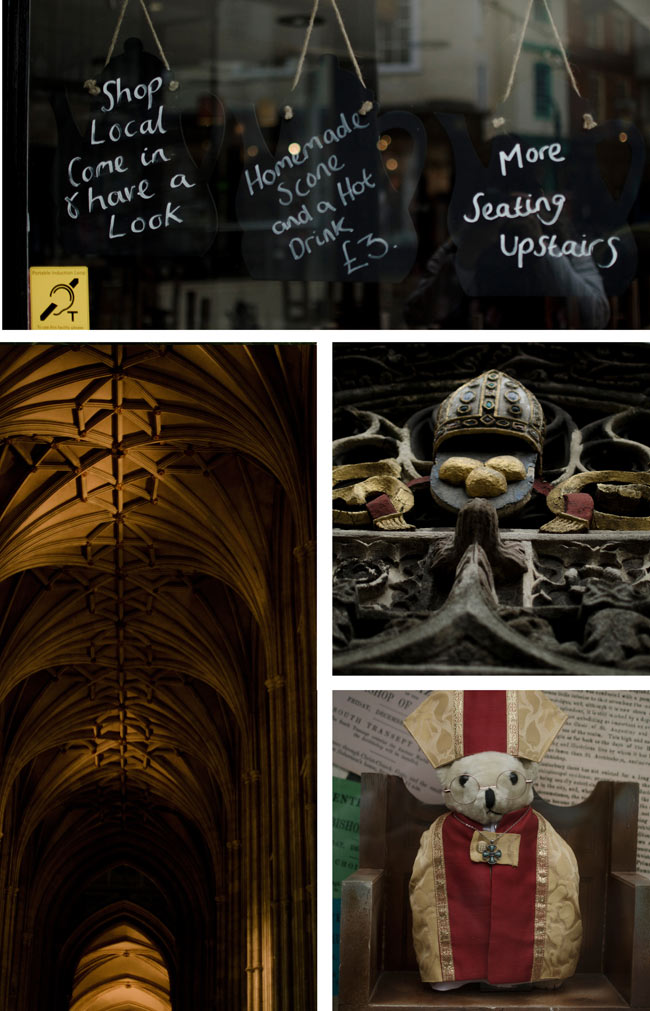
An hour train ride from London you come upon a town in Kent where most of it is a World Heritage site. Yes indeed. Canterbury has one of the oldest monuments to Christianity in the UK, built from stone imported from Normandy, and has stood on the site for over 1,400 years. The Mother Church of the Anglican faith and seat of the Archbishop of Canterbury (cute teddy bears of him can be found around the town if you fancy). Services are held at the Cathedral three or more times a day. We would know since we felicitously came to visit when a sermon was about to start = not having to pay the £9.50 entry fee. We went on Mother's Day and watched a lovely sermon where children handed out daffodil bouquets to everyone that attended. Those same bouquets were left in the hands of statues dedicated to Kent's King and Queen Ethelbert and Bertha, the sexy-as-hell-sounding couple that established the English-speaking Christian civilization that the British Empire became.

Did you know the equestrian word "canter" comes from Canterbury? After the murder of Archbishop Thomas Becket in the cathedral, pilgrims from all parts of Christendom came to visit his shrine. Many pilgrims on horseback who were nearing the city late at night would increase the horse's speed from a trot to the faster "Canterbury trot", but not as fast as a gallop. To "canter" became the shortened expression. It was a secret thrill to stumble upon a pilgrimage sign in front of the cathedral after so many years since doing the camino to Santiago. You can walk to Rome from here! Or walk from Rome to here!

The mind abuzz with walking the Via Francincigena, visiting the Beany House of Art and Knowledge with its miniature doll houses and textile art, tea breaks in cafes to warm up, coming across green and grey graveyards, ancient abbeys, wooden emblems and stained glass windows, this walkable town's slow pace and steeped Roman, Norman and medieval history is a well worth experiencing. Just avoid the Three Tuns if you are feeling peckish - worst pub food we've had to date, and that says alot!


17/03/2013

Kew gardens and Eel Pie Island

On exploration days like this I love London. A while back little Miss Gerbil came to visit from Amsterdam and off we went for a free David Nash tour at Kew Gardens. I would have been none the wiser at understanding his artworks if I had just roamed around the gardens and come across his sculptures without knowing his lifelong exploration of natural materials. We discovered his propensity to work with trees, living ones with their roots still in the ground (which energetically link his works to the site he says) or trees that had succumbed to storm or age or disease, scattered across the 121 hectare site. The one specific statue is from a 300 year-old oak that had been weakened by drought, it became distressed and gave off pheromones which beetles picked up on and moved into. Along the way I saw 2 trees that were the same species, but one was male, the other female, her leaves were completely different and she was smaller. I loved the idea of trees that beckoned beetles to their doom, and husbands and wives that were rooted next to each other forever.

The Gardens houses the world's largest collection of living plants. We saw one of the oldest pot plants in the world, the 238 year-old cycad Encephalartos altensteinii which had been brought from SA in the early 1770s. The name Encephalartos in Greek apparently means ‘bread in the head’. Hottentots would remove the pith from the cycad's stem and bury it for 2 months before kneading it into bread and baking it in embers.


Then something I never expected to find, a new-found female idol known as Marianne North. She was a Victorian artist who travelled the world by herself and recorded the world’s flora with her paintbrush. There is an entire gallery of her works at Kew, filled from floor to ceiling of the natural sights she documented on her travels from Japan to Java. What an inspiration. At the end of the exhibit you could take a tag and write down a memory you have relating to a plant, reading some of the childrens' answers are worth a giggle.


The final stage of the day was a visit to an island on the Thames! Who knew. Close to Twickenham, I was drawn to visiting it by some hearsay that the hippy haven had denounced the Queen way back when, and had formed their own state for a day or two before the bobbies came and put them in their place. This was complete 'bollocks' a resident told me, but from the gnomed, mannequined and crocodiled decor, one could tell its not of the mainstream so to speak. Although a trendy apartment development had recently made its way onto the island, which means bankers will move in at some point and spoil the renegade charm of this artist collective. What a pity. All in a day's walk in London.


06/03/2013

Legible London

As I am sure you have noticed, I like me some pretty typefaces when I come across them. Be they the product of urban scrawls or houseboat signage, DIY lettering or Victorian barber signs, the Queen's greenway or City of London crests, grimey underground placards or art deco hotels, Hackney tags or vandalised telephone boxes, there's always something worth a glance and a quick shot.


02/03/2013

Then and now

When my dad came to visit me in London for a short time a while back, we thought it would be fun to go back to places he had been in London 48 years ago and re-shoot the scenes. Back then he embraced the opportunity to come here on a trip organised by the university he worked for, back then you could not travel without the state's permission and the group had a 'handler' for the journey. Because he seemed to have enjoyed Western culture too much on that occasion, he was detained from leaving Poland on the next trip my mother and father were to take together.

We reproduced 3 tourist scenes: Marble Arch, Piccadilly Circus, and waiting outside Selfridge's on Bond Street for a bus. There was one part of Bond Street we couldn't find, a somewhat family favourite of him crossing the street, looking all suave and collected in the city of flux. Perhaps one of you would know where it is. It was a good few days, walking through these places of memory with my dad, blissfully carefree and enjoying the freedoms that he did not have when he was my age.


11/02/2013

Finally, some snow!

Snow finally arrived! Many a snowball was thrown around Hampstead Heath (that looked magically quiet until reaching Parliament Hill, the place to go apparently with your snow sled and sproglet kids in tow), many off-shaped snowmen were spotted, and much oggling was done on a walk to Audley End (that impressive manor-looking place close to Cambridge). Nothing quite like walking over abandoned rail tracks covered in snow, and following a quietly-trickling river to an English heritage site.


Related Posts Plugin for WordPress, Blogger...